Where ISO 9001:2026 is right now
As of mid-2026, ISO 9001:2026 sits at the Final Draft International Standard (FDIS) stage. The draft was submitted to ISO and CEN members for voting in April 2026, and publication is widely expected around September 2026. Once it publishes, certified organisations get a three-year transition window - to roughly September 2029 - to move across from ISO 9001:2015.
Two things follow from that, and both matter:
- You cannot be certified to ISO 9001:2026 yet. No certification body can audit you against a standard that has not been published. Anyone offering "2026 certification" today is selling something that does not exist.
- The exact final wording can still change. The FDIS is the near-final draft, not the published standard. The direction is settled; the last details are not.
So the honest position - the one we take with our own clients - is this: prepare against the direction the FDIS makes clear, but do not rip up your documented system chasing wording that is not final. That is wasted effort, and it is the opposite of what the standard rewards.
What the FDIS signals is changing
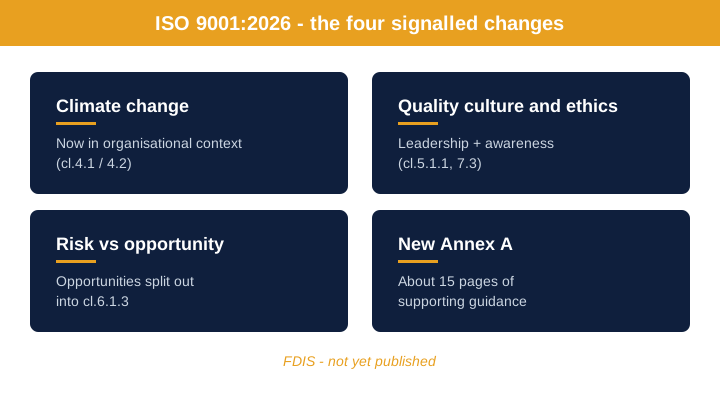
The revision is deliberately evolutionary. The core clauses (4 to 10) carry only minor changes, which means a contractor already running a genuine ISO 9001:2015 system faces a light transition, not a rebuild. The signalled changes cluster in four areas:
| Area | What the FDIS signals | What it means on the ground |
|---|---|---|
| Climate change | Climate becomes an explicit part of organisational context (clauses 4.1 and 4.2) | Climate-related risk - heat, flooding, extreme weather, resource and supply disruption - has to be visible in how you plan and control work |
| Quality culture and ethics | The leadership and awareness clauses (5.1.1 and 7.3) now name quality culture and ethical behaviour | Inductions, toolboxes and leadership behaviour have to demonstrably live the values, not just file a policy |
| Risk and opportunity | Opportunities split out from risks into their own sub-clause (6.1.3) | Opportunities become a tracked, proactive stream with owners and actions - not a footnote to the risk register |
| Annex A (new) | A first-ever annex of supplementary guidance, around 15 pages | Clearer expectations and fewer interpretation arguments with auditors |
These reflect the published FDIS and the transition briefings from the major certification and standards bodies (BSI, SGS, DQS, TUV). We confirm the detail against the published text the day it lands.
What it actually means for civil, mining and infrastructure contractors
Strip away the clause numbers and the changes land in places you already feel on a project:
- Climate is no longer an environmental side-topic. If extreme weather can stop your works, damage temporary works, or cut off supply of aggregate, fuel or labour, that is now a quality-system context issue as well as a safety and environmental one. Contractors already moving to ISO 14001:2026 are carrying this - 9001:2026 brings the quality system into line.
- "Quality culture" gets audited by talking to your crews. Auditors increasingly test culture by asking the people doing the work, not by reading the manual. A leadership team that visibly backs "do it right, not just fast" - and a workforce that can say so - is what the clause is reaching for.
- Opportunities become something you have to show, not just claim. Cutting rework, a better ITP, a smarter Prestartr workflow - the standard now expects these to be captured, owned and tracked, the same way you track a risk or an NCR.
None of this is exotic for a contractor running a real system. It is exotic for a contractor whose system lives in a binder.
How to pre-align now, without wasting effort
You do not need to touch a certificate, and you should not re-document everything. A proportionate plan looks like this:
- Run a direction gap-scan, not a rewrite. Check your current system against the four signalled areas above. Note where you are already covered - most contractors are further along than they think - and where you are thin.
- Fold climate in where it already belongs. If you hold or are moving to ISO 14001:2026, climate context is already required - reuse that work in your quality context rather than inventing a parallel process.
- Split opportunities from risks in your risk process now. It is a small change with a real payback: a live opportunities stream is exactly the continual-improvement evidence auditors and principal contractors want to see.
- Name quality culture and ethics in leadership and induction. One honest paragraph in your leadership commitment and one in your induction, backed by behaviour, does more than a policy nobody reads.
- Watch for Annex A on publication. When the standard lands, the annex will settle several interpretation questions - it is worth a proper read rather than a skim.
Do these across your transition window and the move to ISO 9001:2026 becomes a formality, not a project.
The honest bottom line
ISO 9001:2026 is an evolution, not a revolution. There is no cliff, no urgent recertification, and no reason to panic-document. A contractor whose system genuinely operates - whose audits are a state, not a scramble - has very little to do. A contractor whose system only exists on paper will feel the culture and opportunity changes most, because those are the parts you cannot fake in a binder.
We pre-aligned our own management-system product to the FDIS the moment it published, precisely so the contractors we work with can step across cleanly when the standard lands. If you want a straight read on where your system actually sits against the 2026 direction, that is exactly what a systems check is for.
Founder, Hillview Business Services. 15+ years inside civil construction, mining and infrastructure businesses.