What must Australian contractors do about psychosocial hazards now?
Managing psychosocial hazards is now a legal WHS duty, not a nice-to-have. A person conducting a business or undertaking (a PCBU - your company) must eliminate psychosocial risks so far as is reasonably practicable, and where that is not possible, minimise them so far as is reasonably practicable. This is the same duty structure you already know from physical safety, now applied explicitly to psychological health.
The legal driver is the WHS Regulations, which most jurisdictions amended to add specific psychosocial duties, supported by Safe Work Australia's model Code of Practice: Managing psychosocial hazards at work. It has rolled out state by state. Victoria (which runs its own OHS system, not the model WHS laws) brought in the Occupational Health and Safety (Psychological Health) Regulations 2025, which commenced 1 December 2025, with a supporting Compliance Code. With Victoria in, every Australian jurisdiction now requires employers to identify, assess and control psychosocial hazards.
Here is the part people get wrong: AS/NZS ISO 45003:2021 is a voluntary guideline. It is not the law, it is not certifiable, and holding to it does not, by itself, discharge your legal duty. What it does do is give you a well-structured, internationally recognised method for meeting the mandatory duty. Use it as the how-to; the WHS Regulations and your state Code of Practice are the what-you-must-do.
What is the actual legal duty?
- Identify psychosocial hazards - in consultation with your workers and any health and safety representatives (HSRs). Consultation is itself a legal requirement, not a courtesy.
- Assess the risk - who is exposed, how often, how severe, and in what combinations (hazards often stack).
- Control the risk so far as is reasonably practicable, working down the hierarchy - higher-order controls that redesign the work come before low-level administrative fixes like a wellbeing poster or an EAP flyer.
- Review the controls - and review again after an incident, a complaint, a change in work, or when HSRs request it.
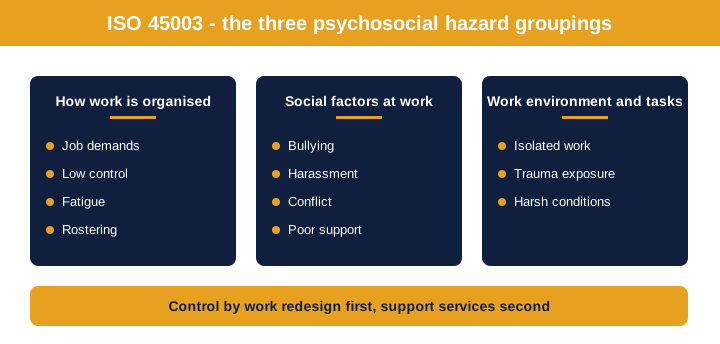
The control step is where regulators are focused. A poster and an employee assistance programme are not a control for an excessive-workload hazard; redesigning the workload, rostering or resourcing is. Work redesign first, support services second.
The three ISO 45003 groupings (with worksite examples and controls)
ISO 45003 sorts psychosocial hazards into three groupings. Safe Work Australia's material lists 14 common psychosocial hazards that map across them. Here they are, framed for a civil, mining or transport worksite.
| ISO 45003 grouping | Example hazards on a contractor worksite | Higher-order control ideas (redesign first) |
|---|---|---|
| How work is organised | High job demands and time pressure; low job control; poor support; long shifts and fatigue; roster and FIFO/DIDO patterns; poor role clarity; badly managed organisational change | Resource jobs realistically and protect programmes from unsafe compression; set fatigue-managed rosters and shift limits; build genuine supervisor support; clarify roles and scopes; plan and consult on change |
| Social factors at work | Bullying; harassment (including sexual harassment); violence and aggression from the public or clients; conflict and poor workplace relationships; poor organisational justice; inadequate reward and recognition | Enforce a real code of conduct with consequences; visible, trusted reporting that is acted on; supervisor training on managing conflict; fair, consistent processes; design out lone client-facing exposure |
| Work environment, equipment and hazardous tasks | Remote or isolated work; exposure to traumatic events or material; poor or harsh physical environment (heat, noise, dust); unreliable or unsafe equipment | Check-in and communications systems for isolated workers; trauma-informed response and peer support after critical incidents; fix the physical environment; maintain plant so equipment stress is not a daily hazard |
The point of the groupings is coverage. Most contractors are decent on the physical environment column and weakest on the "how work is organised" column - fatigue, rostering, job demands and poor support - which is exactly where the highest-frequency psychosocial risk sits on a construction, mining or transport operation.
What it means for civil, mining and transport contractors
- Fatigue and rostering. Long shifts, night work, FIFO/DIDO and compressed programmes are front-line psychosocial hazards, not just physical ones. This is likely your biggest exposure.
- Remote and isolated work. Line crews, surveyors, drivers and single-operator plant need real isolation controls - reliable comms, check-ins and escalation.
- Exposure to trauma. Serious incidents, fatalities and recovery work expose your people to traumatic material. You need a planned, trauma-informed response, not an ad-hoc one.
- Job demands and program pressure. When a head contractor compresses a programme, the psychosocial risk flows straight to your crews. Managing that pressure is now part of your WHS duty.
- Bullying, harassment and a hard-edged culture. Traditional site culture is not a defence. Bullying, harassment and aggression are named hazards you must control.
Practically, most of this bolts onto systems you already run - your existing risk assessments, toolbox talks, consultation arrangements, incident reporting and fatigue management. You are extending them, not starting again.
A practical plan to meet the duty
- Confirm your jurisdiction's rules. Check the WHS Regulations (or Victoria's OHS Psychological Health Regulations) and the Code of Practice or Compliance Code that applies in your state.
- Consult your workers and HSRs first. The people doing the work know where the pressure, isolation and conflict actually are - and consultation is legally required.
- Identify hazards against the 14 named hazards. Walk the Safe Work Australia list and the three ISO 45003 groupings across your real jobs, crews and rosters. Do not skip the "how work is organised" column.
- Assess and prioritise. Rank by likelihood and severity, and look for stacking - fatigue plus isolation plus high demands is worse than any one alone.
- Control with higher-order measures first. Redesign work, resourcing, rosters and supervision before you reach for training, posters or an EAP. Record why each control is reasonably practicable.
- Write it into your existing systems. Add psychosocial hazards to your risk register, SWMS/JSAs where relevant, incident reporting and induction. Use AS/NZS ISO 45003:2021 as the structuring guide.
- Review on a trigger and a cycle. Review after incidents, complaints, work changes or HSR requests, and on a set schedule. Keep records - they are your evidence of due diligence.
Honest bottom line
Psychosocial hazards are a live legal duty across Australia now, and your regulator expects the full identify-assess-control-review cycle with higher-order controls, not a wellbeing poster and an EAP number. AS/NZS ISO 45003:2021 is genuinely useful, but it is voluntary guidance - it helps you meet the law, it does not replace it. For a civil, mining or transport contractor, start with fatigue, rostering, isolation, trauma exposure and job demands, consult your crews, and bolt this onto the WHS systems you already run.
Founder, Hillview Business Services. 15+ years inside civil construction, mining and infrastructure businesses.