Integrated system or separate ISO 9001, 14001 and 45001: which should a contractor run
For most civil, mining, utilities and infrastructure contractors who carry all three - quality (ISO 9001), environment (ISO 14001) and safety (ISO 45001) - an integrated management system (IMS) is the better choice. One system, one set of processes, one reporting cadence, and audits that can be run together. Running the three as separate systems means, in effect, triple the audits, triple the training and triple the paperwork for a business whose quality, environmental and safety work overlaps heavily on every project.
But it is not automatic, and anyone who tells you integration is always right is selling something. If you hold only one standard, or your standards barely overlap, integration is overhead without a payback. The honest answer depends on your scope, not on a rule.
What is the difference between an integrated and a separate management system
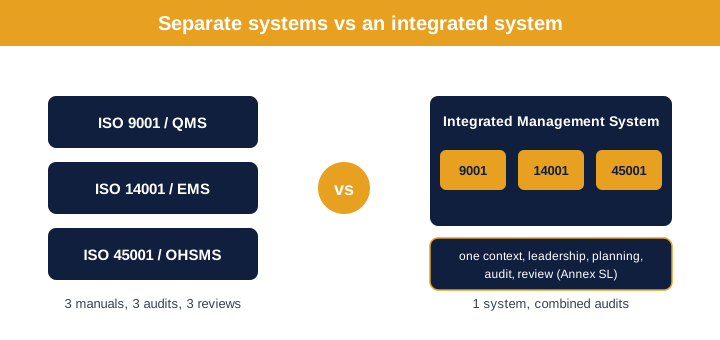
A separate approach maintains three distinct systems: three manuals (or three walled-off sections), three risk processes, three internal audit programmes, three sets of management review. Each certification is prepared for and maintained on its own.
An integrated management system merges the common machinery - context, leadership, planning, support, operation, performance evaluation and improvement - into one system, with the standard-specific requirements handled as focused additions rather than separate builds. You run quality, environment and safety as one discipline, not three parallel ones.
What makes this practical is structural. Since 2021, ISO management system standards share what ISO calls the Harmonized Structure (formerly the High-Level Structure), set out in Annex SL of the ISO/IEC Directives. ISO 9001, ISO 14001 and ISO 45001 are all built on the same ten-clause skeleton, with identical core text and common definitions across large parts of each standard. That shared spine is why integration works: roughly 70 to 80 percent of the requirements are common ground. Note too that the 2024 Annex SL amendments added climate change as a factor organisations must consider in their context - a change that lands once in an integrated system, and three times in separate ones.
Integrated system vs separate systems: a side-by-side comparison
| Factor | Separate systems | Integrated system (IMS) |
|---|---|---|
| Audits | Three audit cycles, often three visits, three lots of preparation | Combined audits assessed in one planned cycle; each standard still evaluated on its merits, but far less disruption |
| Training | Repeated, standard-by-standard, often with overlapping content | One programme covering shared requirements once, with topic-specific additions |
| Documentation | Three manuals and duplicated processes; the same information maintained in three places | One shared framework with standard-specific annexes; mature integrations report meaningfully fewer documents |
| Risk visibility | Quality, environmental and safety risks assessed in separate boxes; gaps between them go unseen | Risks to quality, environment and safety seen together, so trade-offs and overlaps surface in one place |
| Cost and effort | Higher ongoing cost; synergies between the standards go largely unrealised | Lower long-term cost - shared audits, single review cadence, less duplicated maintenance |
| When it fits | One standard, or genuinely low-overlap operations | Two or more standards with overlapping scope on the same projects |
Certification bodies and assurance providers such as Intertek, SGS and DNV all now offer combined auditing precisely because the underlying systems overlap so much. In a combined audit, the standards are assessed in parallel during one cycle - each still judged independently, but planned and run together so you prepare once, not three times.
What it actually means for civil, mining and infrastructure contractors
- One risk conversation, not three. On a civil job, a change to a work method affects quality, environment and safety at the same time. In separate systems that change gets assessed three times, in three registers - and the gaps between them are exactly where incidents and NCRs live. An IMS puts that conversation in one place.
- Tenders and prequalification get simpler. When a principal asks for your QA, environmental and safety credentials, an integrated system tells one coherent story instead of three that do not quite line up.
- Less audit season, more audit state. Combined surveillance means one preparation effort a year, not a rolling scramble across three certificates.
- Your crews see one system. The single biggest failure of separate systems on site is that the people doing the work face three sets of forms and rules for what feels like one job.
The important caveat: integration changes operational practice, not just documentation. Merging three manuals into one binder while still running three separate processes underneath gets you the cost of change and none of the benefit. Real integration means one risk process, one cadence, one improvement loop.
When separate systems are the right call
- You hold only one standard. There is nothing to integrate. Run it well.
- Your standards barely overlap. If your environmental or quality exposure is genuinely minor and unrelated to your safety-critical work, the shared machinery buys you little.
- One standard is mature and the others are new. Sometimes it is cleaner to stabilise a new system before folding it into a working one, then integrate later.
Integration is clearly worth it for organisations carrying two or more standards with overlapping scope - which is most civil and mining contractors. It is overhead without proportional benefit for a single-standard or low-overlap operation.
How to decide and move sensibly toward an IMS
- Count your standards and their overlap. Three standards on the same projects is a strong case. One standard, or three that rarely touch, is not.
- Look at whether your risks already interact. If a single method change routinely touches quality, environment and safety at once, separate systems are already costing you in missed connections.
- If you are integrating, integrate the process, not just the binder. One risk register, one management review, one internal audit programme, one improvement loop.
- Talk to your certification body about combined auditing before you restructure. They can align your surveillance so you get the audit-day payback.
- Do not rip up a working system to chase tidiness. If quality is mature and environment is brand new, stabilise first, integrate second.
Remember that Hillview is operations-first, not a certification body - we help you build and run the system; the certificate itself comes from an accredited auditor.
The honest bottom line
For the typical civil, mining or infrastructure contractor carrying all three of quality, environment and safety, an integrated management system is the better answer: less duplication, combined audits, one risk conversation and a system your crews actually recognise. The Annex SL Harmonized Structure is what makes it practical. But integration is a change to how you operate, not a document merge - and for a single-standard or low-overlap business it is overhead you do not need. If you want a straight read on whether an IMS is right for where you actually sit, that is worth a proper look before you restructure anything.
Founder, Hillview Business Services. 15+ years inside civil construction, mining and infrastructure businesses.