Is your audit prep a sign your system is not working?
If getting ready for an audit takes your team weeks of nights and weekends, that is not a sign you are thorough. It is a sign your management system is not actually operating between audits. Audit-ready is a state you run in, not a scramble you perform twice a year.
The honest test is simple. When the auditor confirms a date, does your team feel a jolt of dread or a shrug? A system that genuinely operates produces its own evidence as a by-product of the work. There is nothing to assemble because it was never disassembled. A system that only exists on paper has to be reconstructed each cycle, and that reconstruction is the scramble.
Why does the audit scramble happen?
The scramble happens for one root reason: the evidence is being created for the audit rather than by the work.
You can see it in the tells. Registers that were last updated the week before the auditor arrives. SWMS signed in a single sitting with the same date and the same pen. NCRs that were "closed out" in a burst of catch-up. Toolbox records written from memory. Photos taken retrospectively to prove an inspection that no one can quite remember doing.
None of that is fraud. It is what happens when the system is treated as a documentation exercise that sits beside the real work instead of a way of doing the real work. Auditors test a system by talking to the people doing the work and comparing what they say to what the records claim. A reconstructed record rarely survives that conversation.
What does "audit as a non-event" actually look like?
| The scramble | The state |
|---|---|
| Evidence assembled in the weeks before | Evidence produced continuously by the work |
| Registers updated just before the visit | Live registers, updated as things happen |
| NCRs closed in a catch-up burst | NCRs closed as they arise, with verification |
| Records written from memory | Records captured in the flow, on the day |
| Team dreads the date | Team treats the date as routine |
| Findings are a surprise | You already know what the auditor will find |
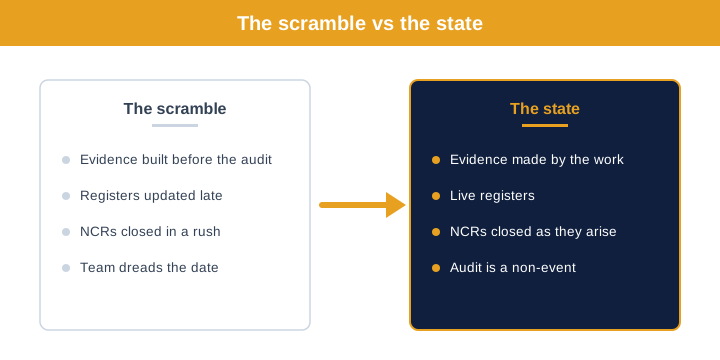
The deepest marker of the state is that you are not surprised by the findings. Your own internal audits and daily records surface them before an external auditor ever could. The external audit confirms what you already know rather than revealing what you missed.
What operating habits make evidence a by-product of the work?
- Records captured in the flow, not after it. When the prestart, the inspection and the sign-off happen on a device in the crew's hand at the moment of the work (through Prestartr or a similar field tool), the record carries a real timestamp and a real location because it was made at the real moment.
- Live registers, not periodic ones. Your risk register, plant register, training and competency matrix, and calibration records are updated as reality changes, not refreshed before a visit.
- NCRs closed as they arise. A non-conformance is raised when it is found, actioned, and closed only when the fix is verified. Done in arrears, it is the single biggest lump of the scramble.
- Internal audits that actually bite. Under ISO 9001 and 45001, internal audit at planned intervals is a requirement, not an optional extra. Run against the same criteria an external auditor uses, your own audits become the early warning system.
- Lead indicators watched, not just lagging ones. Inspections completed, actions closed on time, toolbox attendance. These tell you the system is being used this week.
What it means for civil, mining and infrastructure contractors
- The scramble does not scale. On a two-crew job you can brute-force the paperwork before an audit. Across multiple sites, plant fleets and shifting crews, reconstruction becomes impossible.
- Field-captured records are the highest-trust evidence you can hold. A timestamped, geolocated prestart done on site is worth more to an auditor, a principal and a regulator than a perfect document written in the office a fortnight later.
- Your NCR history is a feature, not a confession. A live record of non-conformances raised and closed with verified fixes demonstrates a system that catches and corrects itself.
- The same records that pass the audit win the tender. The evidence a working system produces daily is the same evidence a principal asks for during contractor assurance.
What to do to move from scramble to state
- Move capture to the point of work. Put prestarts, inspections and sign-offs on a device in the crew's hands so the record is made at the moment of the work.
- Make your registers live. Assign owners to the risk, plant, training and calibration registers and update them as things change. Ban the pre-audit refresh.
- Close NCRs on a short clock. Raise, action and verify as you go. Track the recurrence rate so you know the fixes are holding.
- Run internal audits that mean it. Schedule them at planned intervals, audit against the external criteria, and treat every finding as a free warning.
- Watch a few lead indicators weekly. Inspections done, actions closed on time, attendance.
- Stop preparing for audits. The moment audit prep becomes a project on someone's calendar, you have proof the system is not operating. The goal is to have nothing to prepare.
The honest bottom line
Audit-ready is not something you achieve in the fortnight before the auditor arrives. It is a state you either run in or you do not. A contractor whose system genuinely operates, whose records are made by the work rather than for the audit, has almost nothing to do when the date is confirmed. The scramble is not the price of a good audit. It is the symptom of a system that only exists on paper. Fix the operating habits and the audit becomes what it should be: a day someone visits and confirms what you already knew. If you want a straight read on why your audits still feel like a scramble, that is usually a short and useful conversation.
Founder, Hillview Business Services. 15+ years inside civil construction, mining and infrastructure businesses.